
APEO-Free & Environmentally Responsible Solutions
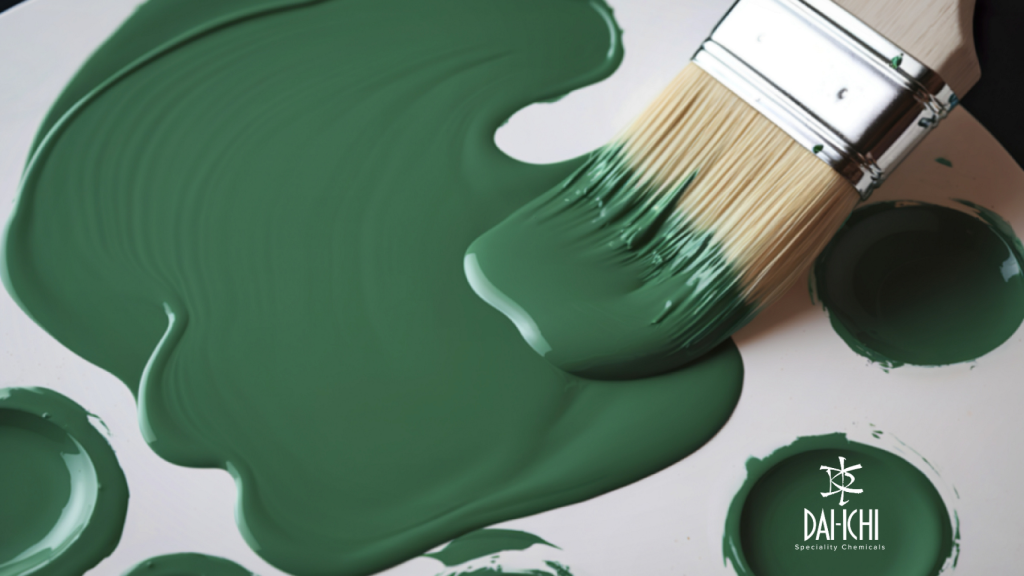
Advancing Sustainable Performance in Water-Based Paints
As the paints industry continues its transition toward environmentally responsible formulations, the elimination of hazardous substances has become a key priority. Among these, Alkylphenol Ethoxylates (APEOs) have come under increasing regulatory and environmental scrutiny due to their persistence, toxicity, and impact on aquatic ecosystems.
For paint manufacturers, this shift is about compliance and about redefining formulation strategies to achieve sustainability without compromising performance. At Dai-ichi, we are at the forefront of this transition, developing APEO-free surfactant and dispersing solutions tailored for modern water-based paint systems.
Understanding the Concern Around APEOs
APEOs have historically been widely used in paint formulations as emulsifiers, wetting agents, and dispersants due to their effectiveness and cost efficiency. However, their degradation products, such as nonylphenol, are known to:
- Exhibit endocrine disrupting properties
- Persist in the environment and bioaccumulate
- Pose risks to aquatic life
As a result, global regulations and eco-label standards are increasingly restricting or eliminating their use in coatings and paints.
The Shift Toward APEO-Free Paint Formulations
The move toward APEO-free systems is driven by:
- Stringent environmental regulations and compliance requirements
- Growing demand for eco friendly and low impact products
- Increased awareness among consumers and manufacturers
However, replacing APEOs is not straightforward. Conventional alternatives often face challenges such as:
- Reduced wetting efficiency
- Foam generation issues
- Compatibility limitations
- Trade-offs in dispersion stability
This makes the development of high-performance APEO-free systems a critical need for the industry.
Dai-ichi’s Approach to APEO-Free Solutions
At Dai-ichi, we focus on designing next-generation surfactant and dispersing systems that deliver both sustainability and performance. Our APEO-free solutions are engineered to:
- Ensure effective pigment wetting in aqueous systems
- Enable efficient dispersion and stabilization
- Maintain formulation balance without excessive foaming
- Provide compatibility across a wide range of binders and additives
By optimizing interfacial chemistry, we help formulators transition to APEO-free systems without compromising on quality or process efficiency.
Performance Without Compromise
Dai-ichi’s APEO-free technologies enable water-based paint formulations to achieve:
- Consistent Color Development: Efficient dispersion ensures strong and uniform color performance.
- Improved Opacity & Finish: Enhanced particle distribution supports better hiding and film appearance.
- Controlled Foam Behavior: Balanced surfactant systems minimize foam related defects.
- Stable Formulations: Long-term stability is maintained without sedimentation or phase separation.
- Regulatory Confidence: Formulations aligned with global environmental standards.
Supporting Sustainable Paint Innovation
The future of paints lies in high performance, environmentally responsible formulations. APEO-free systems are a critical step in this direction, enabling manufacturers to meet both regulatory and market expectations.
At Dai-ichi, sustainability is integrated into our innovation strategy. Through continuous investment in R&D and application development, we are committed to delivering advanced chemical solutions that support safer, cleaner, and more efficient paint formulations.
Conclusion
The transition to APEO-free formulations represents a significant shift in the paints industry, one that demands both technical expertise and innovative chemistry.
With a strong focus on surfactant and dispersant technologies for water-based systems, Dai-ichi enables formulators to achieve environmental compliance, formulation stability, and high performance; all in one system.
📞 +91 72087 26483 🌐 www.dai-ichiindia.com 📩 sales@dai-ichiindia.com
- Improving Colour Development Through Better Pigment Dispersion
- How Surfactant Structure Affects Performance in Textile Auxiliaries
- Importance of Specialty Chemicals in Sustainable Agrochemical Formulations
- How Dispersant Chemistry Controls Particle Stability in Agrochemical Formulations
- Formulation Strategies for Multi-functional Home Care Products