

Oilfield Chemicals for High Pressure, High Temperature (HPHT) Environments
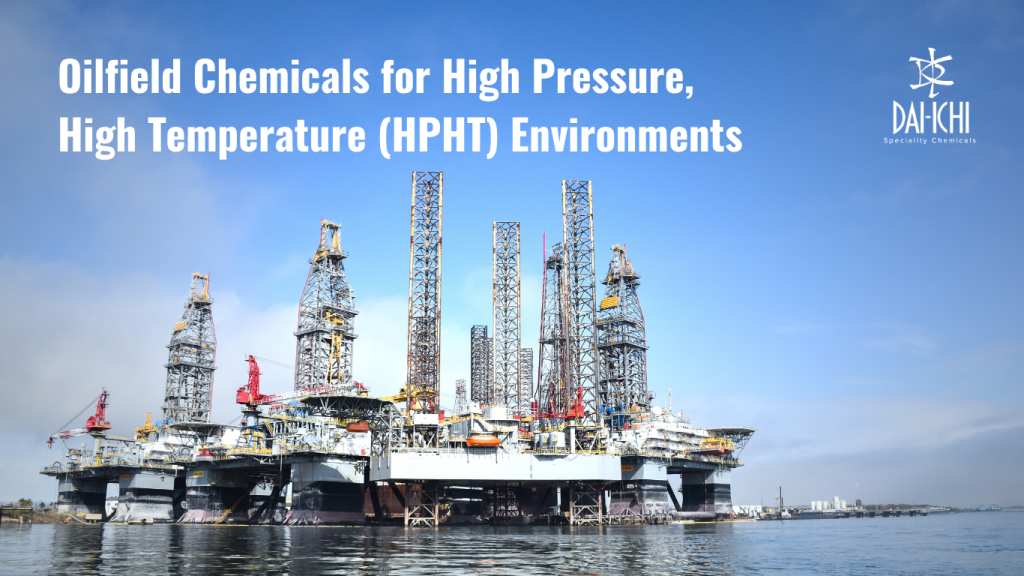
As the oil industry advances into deeper reservoirs and more complex geological formations, High Pressure, High Temperature (HPHT) environments are becoming the operational norm. These extreme conditions introduce a new level of complexity, where conventional oilfield chemistries often reach their functional limits.
In HPHT systems, flow assurance and production efficiency are governed by a dynamic interplay of thermal stress, pressure induced phase behavior, and accelerated reaction kinetics. Chemical solutions that perform reliably under standard conditions frequently fail when exposed to elevated temperatures and pressures, leading to instability, loss of performance, and increased operational risk.
Shift in Chemical Performance Requirements
Operating environments exceeding 150°C temperatures and 10,000+ psi pressures significantly alter the behavior of complex crude chemistries and the chemicals used to treat them. Under these conditions:
- Molecular structures face intense thermal stress
- Fluid equilibria shift, impacting solubility and dispersion
- Deposition kinetics accelerate, reducing response time
The result: Traditional formulations lose effectiveness, making advanced chemical engineering essential.
Why Conventional Chemistries Fail in HPHT Conditions
1. Thermal Degradation of Active Molecules
At high temperatures, conventional polymer and surfactant-based chemistries undergo molecular breakdown, loss of labile functional groups, thereby reduced interaction with wax, asphaltenes, and scale leading to lower efficiency in key applications.
2. Pressure Induced Phase Instability
High pressure significantly alters crude oil morphology by gradual increase in viscosity, gel point and structural compactness. As a result, it triggers wax and asphaltene precipitation, affecting solubility, therefore destabilizing emulsions making treatment performance unpredictable.
3. Accelerated Deposition Kinetics
HPHT conditions destabilize the crude oil colloidal behavior and promote a faster solid phase deposition of wax, asphaltenes, and scale. With limited phase transition time, chemicals must act rapidly to prevent flow disruption.
The Dai-ichi R&D Approach
At Dai-ichi, we manufacture chemicals from the ground up to withstand and perform under HPHT stress conditions to maintain the crude viscosity. Our focus is on molecular stability, functional efficiency, and system compatibility.
1. Thermally Stable Polymer Architectures
We develop most specialized copolymer systems designed to retain structural integrity at high temperatures:
- Enhanced functional group stability to resist thermal breakdown
- Optimized molecular weight distribution for consistent performance
- Controlled the polarity to sustain interaction with paraffin under thermal stress
These innovations ensure continued effectiveness in flow modification and wax control.
2. Pressure Resilient Surfactant Systems
Our surfactant technologies are engineered to maintain performance under fluctuating pressure conditions:
- Stable interfacial activity across pressure variations
- Effective dispersion of asphaltenes and organic solids
- Improved emulsion control in dynamic environments
3. Multi Functional Chemical Design
In HPHT environments, efficiency is critical. We design integrated solutions that address multiple challenges simultaneously:
- Combined wax inhibition and asphaltene stabilization
- Flow behavior modification with reduced chemical loading
- Synergistic formulations for enhanced overall performance
Advanced Testing: Simulating Real-World HPHT Conditions
A key differentiator in Dai-ichi’s approach is our emphasis on field relevant validation. We replicate extreme conditions in controlled environments to ensure our chemistries perform where it matters most. Our evaluation capabilities include:
- HPHT Rheological Analysis: Measuring viscosity and yield stress under simulated pressure and temperature
- Thermal Aging Studies: Assessing long term chemical stability
- High Pressure PVT Analysis: Understanding fluid phase behavior and interactions
- Dynamic Flow Loop Testing: Simulating real pipeline conditions
Conclusion: Engineering for the Future of Oilfields
As exploration and production continue to push into more extreme environments, the demands on oilfield chemistry will only intensify. HPHT conditions represent not just a challenge but an opportunity to redefine performance standards through innovation. The future of oilfield chemicals lies in precision engineered, application specific solutions that are built to perform under the harshest conditions.
At Dai-ichi, we are committed to leading this evolution leveraging advanced R&D, deep technical expertise, and a problem-solving mindset to deliver chemicals that perform where conventional solutions fall short.
Looking to enhance performance and reliability in extreme operating environments?
📞 +91 72087 26483 🌐 www.dai-ichiindia.com 📩 sales@dai-ichiindia.com
- Improving Colour Development Through Better Pigment Dispersion
- How Surfactant Structure Affects Performance in Textile Auxiliaries
- Importance of Specialty Chemicals in Sustainable Agrochemical Formulations
- How Dispersant Chemistry Controls Particle Stability in Agrochemical Formulations
- Formulation Strategies for Multi-functional Home Care Products