Specialty Sizing Agents: Enabling Performance in High Speed Synthetic Yarn Processing
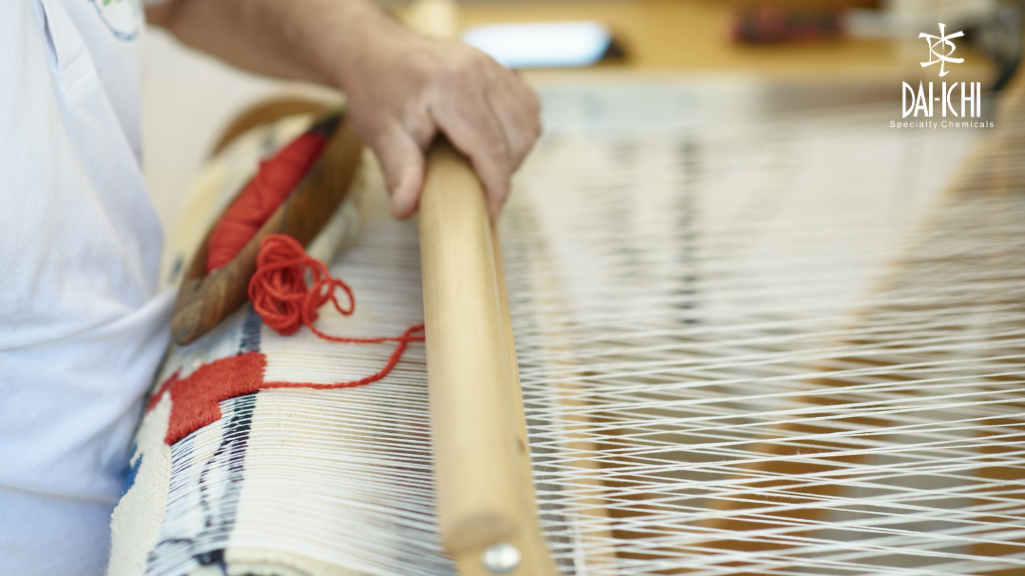
As weaving speeds increase and synthetic yarn constructions become more demanding, sizing chemistry plays an increasingly important role in maintaining yarn integrity and process consistency. For polyester and nylon yarns, the challenge is not simply to increase strength, but to control filament cohesion, surface friction and abrasion resistance without compromising yarn flexibility or downstream processability.
Specialty sizing agents address these interdependent requirements by modifying the yarn surface and helping filaments withstand the mechanical stresses encountered during weaving. Their effectiveness depends on the interaction between polymer film properties, yarn characteristics and operating conditions.
Sizing Chemistry and Filament Cohesion
Unlike spun yarns, continuous filament yarns consist of multiple filaments that must remain sufficiently cohesive during processing. Repeated contact with guides, heddles and reeds can cause filament separation, abrasion and filament breaks, particularly when surface protection and lubrication are inadequate.
The performance of a sizing agent depends partly on its ability to form a uniform film with suitable adhesion to the synthetic substrate. Polymer chemistry, molecular structure, film flexibility and surface characteristics influence how effectively the sizing layer binds filaments together and withstands mechanical stress.
Polyester and nylon also differ in their surface chemistry and moisture response. Consequently, a sizing formulation suitable for one substrate may not deliver equivalent performance on another. Compatibility between the sizing polymer and yarn surface is an important consideration in formulation development.
Balancing Film Strength, Flexibility and Friction
A sizing film must provide sufficient mechanical protection without creating excessive stiffness or friction. These requirements can be difficult to optimize independently.
Film strength and abrasion resistance: The sizing layer must withstand repeated mechanical contact and help limit filament damage. Film integrity and adhesion influence how well the coating remains on the yarn during processing.
Flexibility and elongation: A film that is excessively brittle may crack or shed under repeated bending and tension changes. Adequate flexibility helps the coating accommodate yarn movement without losing its protective function.
Frictional behaviour: Yarn to metal and yarn to yarn friction influence yarn movement through the weaving system. Appropriate lubrication can support smoother passage through machine components, while excessive lubrication may affect filament control or the behaviour of the sized yarn.
Filament binding: Cohesion helps control filament separation and surface disturbance. The required balance depends on yarn construction, filament fineness and the mechanical demands of the weaving process.
Sizing performance therefore depends on the combined behaviour of the polymer film and any functional additives, rather than on a single property such as tensile strength or viscosity.
Optimising Sizing Formulations for High-Speed Processing
At high processing speeds, small variations in application conditions can influence coating uniformity and reproducibility. Sizing bath concentration, viscosity, temperature, application rate and drying conditions all contribute to the amount and distribution of size deposited on the yarn. Insufficient or uneven size add-on may leave parts of the yarn inadequately protected. Excessive add-on, however, can increase stiffness, affect yarn handling and complicate subsequent removal.
The objective is to establish an application window that delivers the required film properties while maintaining stable processing conditions. Key parameters for evaluation include:
- Size add-on and uniformity: The quantity and distribution of sizing material across the yarn sheet.
- Film formation: Adhesion, continuity and flexibility of the deposited layer.
- Friction and abrasion: Surface interaction with machine components and resistance to repeated mechanical contact.
- Drying and residual moisture: Conditions influencing film development and yarn handling.
- Desizing performance: The ability to remove residual sizing material without adversely affecting subsequent dyeing or finishing.
Evaluating these parameters together helps identify trade-offs and establish conditions suited to the yarn construction and production process.
Specialty Sizing Solutions from Dai-ichi
Synthetic yarn sizing requires a balance of filament cohesion, abrasion resistance and friction control. Dai-ichi offers specialty sizing chemicals and supporting additives for polyester and nylon yarn processing, including acrylic copolymer aqueous emulsions, lubricating waxes, antistatic agents and after-oil lubricants.
Its acrylic copolymer emulsions are used in sizing applications involving polyester textured yarn, polyester filament yarn and nylon filament yarn, including water-jet weaving. Supporting additives help address lubrication, friction, abrasion and static charge, depending on the application requirements.
Selecting and combining these components requires consideration of yarn characteristics, weaving conditions and downstream processing needs. A formulation developed for one application may require adjustments when the substrate, yarn construction or operating conditions change.
Explore Dai-ichi’s textile auxiliaries and sizing solutions to learn more about its portfolio for textile processing.
Evaluating Performance Under Industrial Conditions
Laboratory testing provides an initial assessment, but sizing performance must be validated under representative production conditions. Key parameters include size add-on uniformity, film integrity, abrasion resistance, friction, filament separation and desizing behaviour.
Industrial trials can also assess yarn break frequency, loom stoppages and fabric consistency. Evaluating these factors together helps identify formulation adjustments suited to specific yarn constructions and operating conditions.
Advancing Synthetic Yarn Processing Through Specialty Chemistry
Consistent sizing performance depends on matching polymer film properties, lubrication and application conditions to the requirements of each yarn construction. Evaluating these factors together helps translate formulation characteristics into reliable performance on the weaving floor.
At Dai-ichi, we develop application-driven specialty chemical solutions for textile processing, with a focus on addressing the requirements of specific substrates and industrial applications.
Looking to optimize synthetic yarn processing? Connect with Dai-ichi to discuss your textile processing requirements.
📞 +91 72087 26483 🌐 www.dai-ichiindia.com 📩 sales@dai-ichiindia.com